
Why this question is coming up now
"We can build this ourselves with an AI agent." We hear it more and more and we understand why. AI has made it easier than ever to write software and the tools are better, faster and more accessible than they were even a year ago. If you lead a fashion brand today, the question is a fair one to ask.
We don't argue with the ambition. We do want to ask a different question in return: is the value in the code, or in what the code knows?
The hidden value: what the code knows
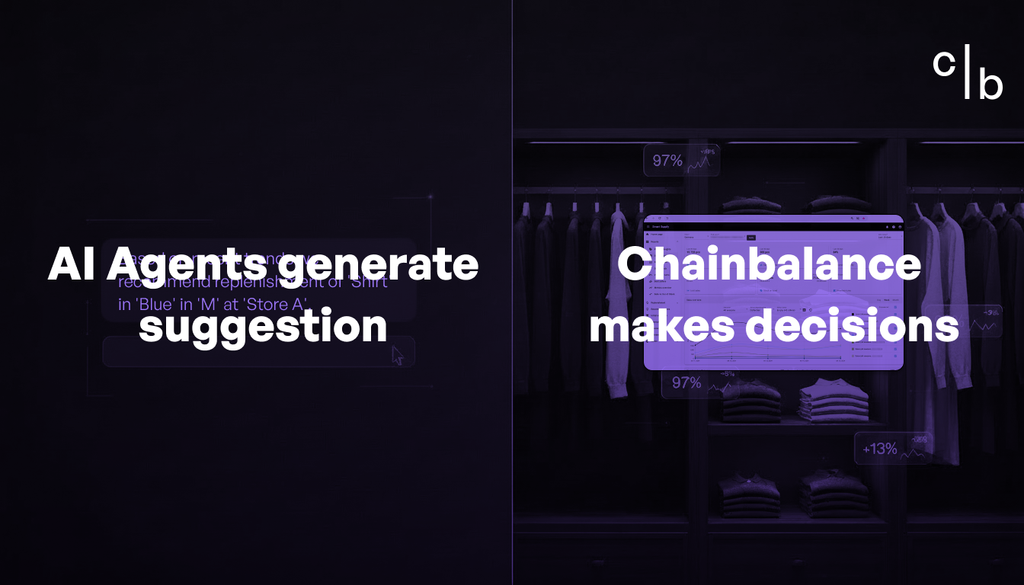
An AI agent can generate a recommendation. But someone still has to decide which data goes in, how the business rules are defined and what counts as a good outcome.
Consider a few questions that only come up in practice:
- Does a size 38 in German wholesale behave the same way as a size 38 in Dutch retail?
- How does a size curve in footwear differ from one in denim?
- How do weather, seasonality, store clustering and retailer constraints interact over a season?
These answers are not visible in a dataset on day one. They become visible only after thousands of real decisions, across different markets, seasons and assortments.
That is the part we have spent more than 20 years building. Chainbalance has worked with more than 60 fashion brands across pre-season and in-season management, from initial allocation to store transfers and order proposals. Every rule and every model and logic was refined as a result of our vast experience with different brands, different sectors in apparel and different ways of working.
"20 years of experience is nothing you can prompt your way to."
What an AI agent actually is
To make a sound decision, it helps to be precise about the technology.
An AI agent combines a language model with data access, tools, instructions, business rules and workflow logic. It can read, reason and respond. In the right setup, it can also trigger actions. That is genuinely powerful.
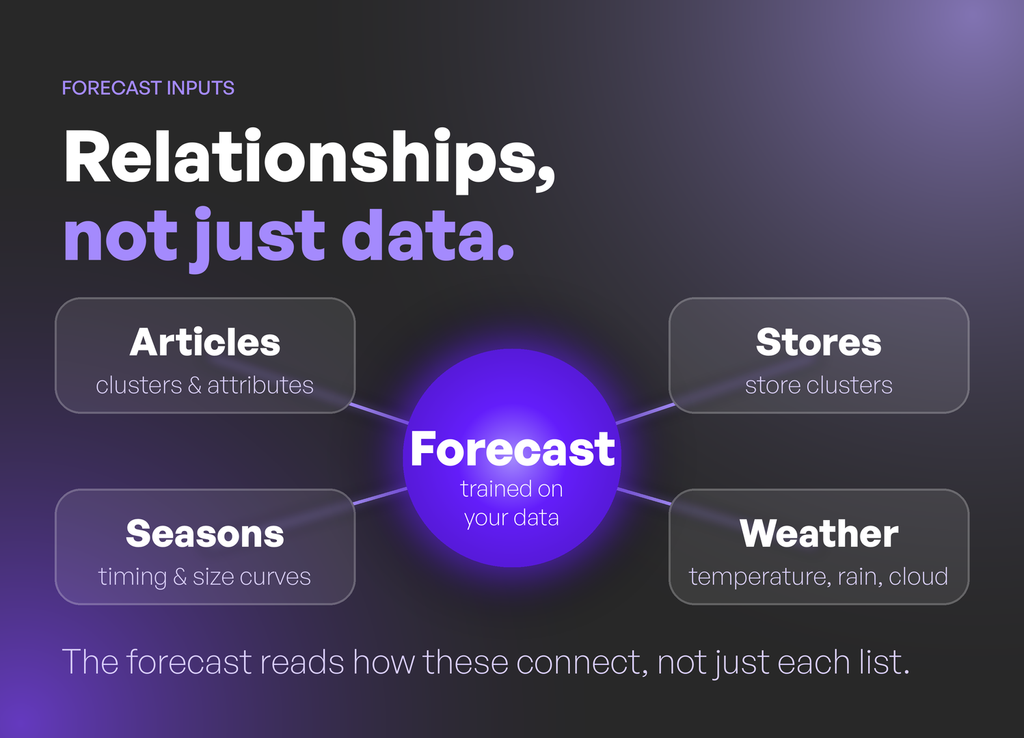
But connecting data does not mean understanding it. An agent can access product data, sales, inventory, pricing and supplier information, but only where those sources are authorised, integrated and consistently defined. Reading the data does not guarantee that the relationships between articles, store clusters, time periods and business definitions are interpreted correctly.
Merchandise management depends on exactly those relationships. A forecast has to reflect how articles cluster, how stores behave, how sales respond to seasonal timing and weather and how stock targets, size curves and replenishment frequency interact. Generating an answer is the easy part. Turning that answer into a traceable inventory decision that connects to your ERP, every day and at scale, is where the complexity lives.
Clean, consistent data is the starting point. Recommendations that connect to actual orders, rather than answers in a chat window, are the goal.
Four questions to ask before you start building
If you are seriously considering building your own merchandise management solution with AI, we would suggest answering these four questions honestly first.
- How long will it really take? A basic agent is relatively quick to build. A production-grade system that understands your data structures, applies your business definitions and stays accurate as your data changes is a different project. Cleaning, mapping and reconciling data across systems, modelling the relationships between articles, stores, sales, timing and weather, and adding permissions, approvals, logging and rollback before the system can take action: this is where the months go.
- Who will own the logic over time? Software does not maintain itself. Assortments change, markets shift, new brands and channels come in and teams evolve. Someone needs to own the merchandise logic, keep it accurate and keep up with the business. Ask who in your organisation will carry that responsibility after launch.
- What is the better use of the next 12 to 24 months? Building a merchandise solution from scratch is a serious investment of time and budget. The alternative is to use that time to make better inventory and assortment decisions now. Both are real choices, but only one of them is likely to affect the results of the coming season.
- How will you know it outperforms? How would you judge whether your in-house solution is performing better than a system that has been trained on two decades of fashion-specific data from more than 60 brands? Define the benchmark before you start, not after.
Where a trained solution fits
None of this is an argument against technology. It is an argument for being honest about what it takes to make it work in a domain as complex as fashion merchandise management.
Chainbalance's forecasting model is trained on client-specific data: your stores, your customers and your sales patterns, rather than generic retail logic. It is refined based on outcomes, not on static rules. And it is designed to produce decisions that can be acted upon, not only suggestions.
Our modules cover the full season, from pre-season planning to in-season management:
- Smart Initial Allocation and Smart PO Forecast for pre-season decisions
- Smart Replenishment, Smart Order Proposals, Smart Store Transfers and Assortment Planning for in-season management
You do not have to start from scratch to benefit from what we have already learned.
The takeaway
Building with AI is possible. The question is whether your team should spend its next season building the foundations or using a proven foundation to make better decisions now.
If you want to explore that question for your brand, we are happy to have an honest conversation. Our case studies show how fashion brands have worked with us, and our team can show you the solution live.