
Never-Out-of-Stock (NOS) products are your quiet heroes: customers expect them always to be available and they make up a significant share of turnover and loyalty. But keeping them permanently available without drowning in stock is anything but simple. Here’s a practical how-to guide on using Smart PO Forecasting to manage NOS products smarter, leaner and more sustainably.
1. Start with the right mindset: what approach does NOS need?
The first step is accepting that NOS can’t be treated like seasonal fashion. Instead of one big purchase order per season and “hoping for the best”, NOS needs continuous fine-tuning. The goal is clear: high availability with as little capital tied up as possible. Traditional methods like static size curves, Excel sheets and generous safety stocks simply don’t cut it anymore in the volatile apparel market.
2. Move beyond Excel: connect your data
To get started with Smart PO Forecasting, make sure your core data flows are in place:
- Warehouse stock
- POS Sales data
- Purchase orders
Smart PO Forecasting uses this data to replace manual Excel sheets with a central forecasting engine. Instead of each planner building their own logic in spreadsheets, the forecasting engine becomes the single place where demand is calculated and turned into purchase order suggestions. This removes duplicate work, reduces errors and gives everyone the exact source of truth.
Through a red warning system, it is even easier to avoid running out of stock on specific sizes, for example, if one of your sizes’ DC forward cover is smaller than the production and transportation lead time.
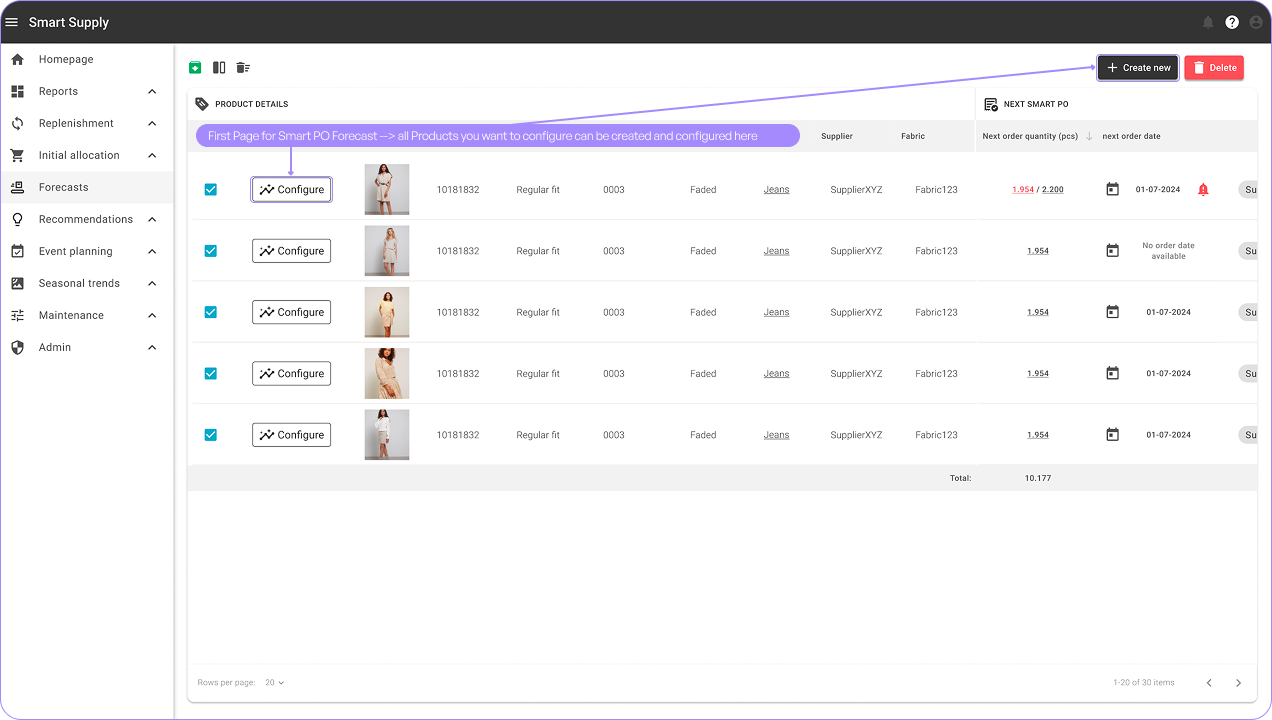
3. Let Smart PO Forecasting learn from your demand
Each articles’ demand is forecasted for each size for each week. To make the connection between forecast and reality, after the week has passed, we update the table with the actual demand. If we see difference, we adapt by moving our suggested order dates or adapting the order quantities, so in our system our forecast and the adaptability to react is updated continuously.
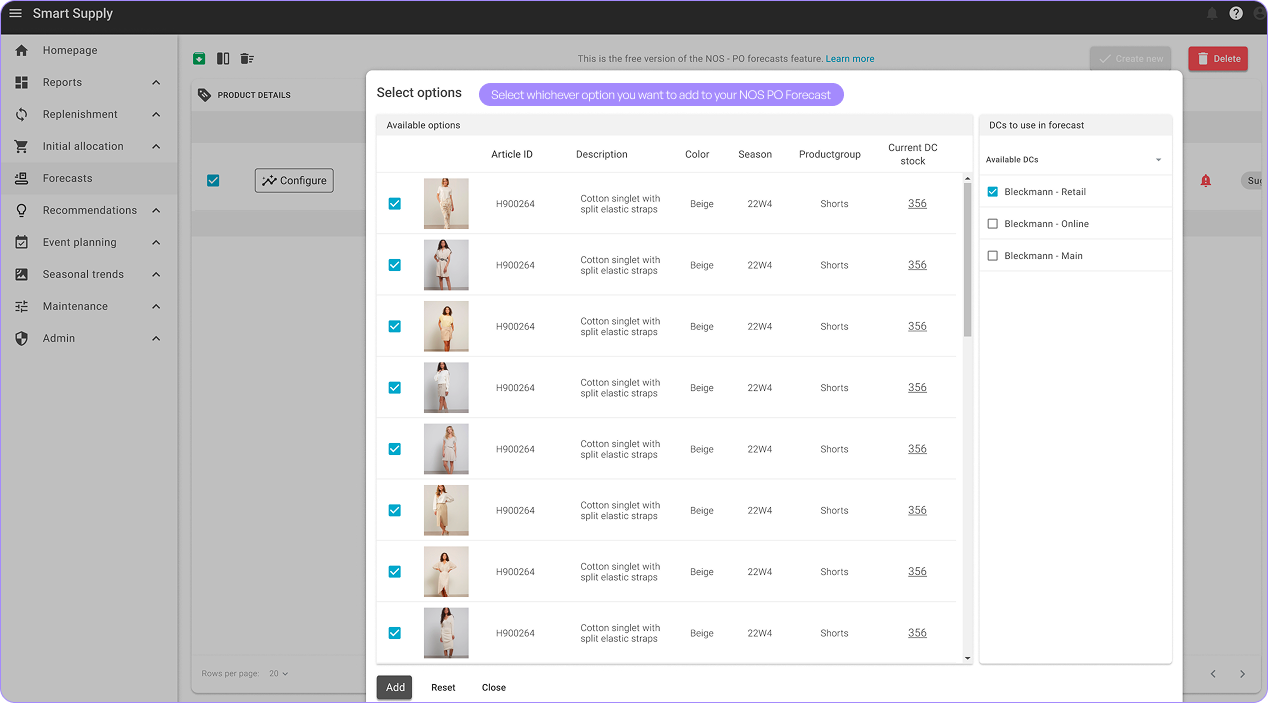
4. Forecast in detail: size and option level, instead of product group
One of the most powerful steps is going granular and forecasting on SKU Level:
- Forecast per size
- Forecast per colour/option
- Respect different lifecycles within the same product group
This means you can:
- Raise orders for strong basics (e.g. black, navy)
- Keep fashion colours lean until they prove themselves
- Reduce safety stock because you finally know where risk sits
You’re no longer planning “a t-shirt” or “a shoe”, but the exact mix of options for what your customers actually buy.
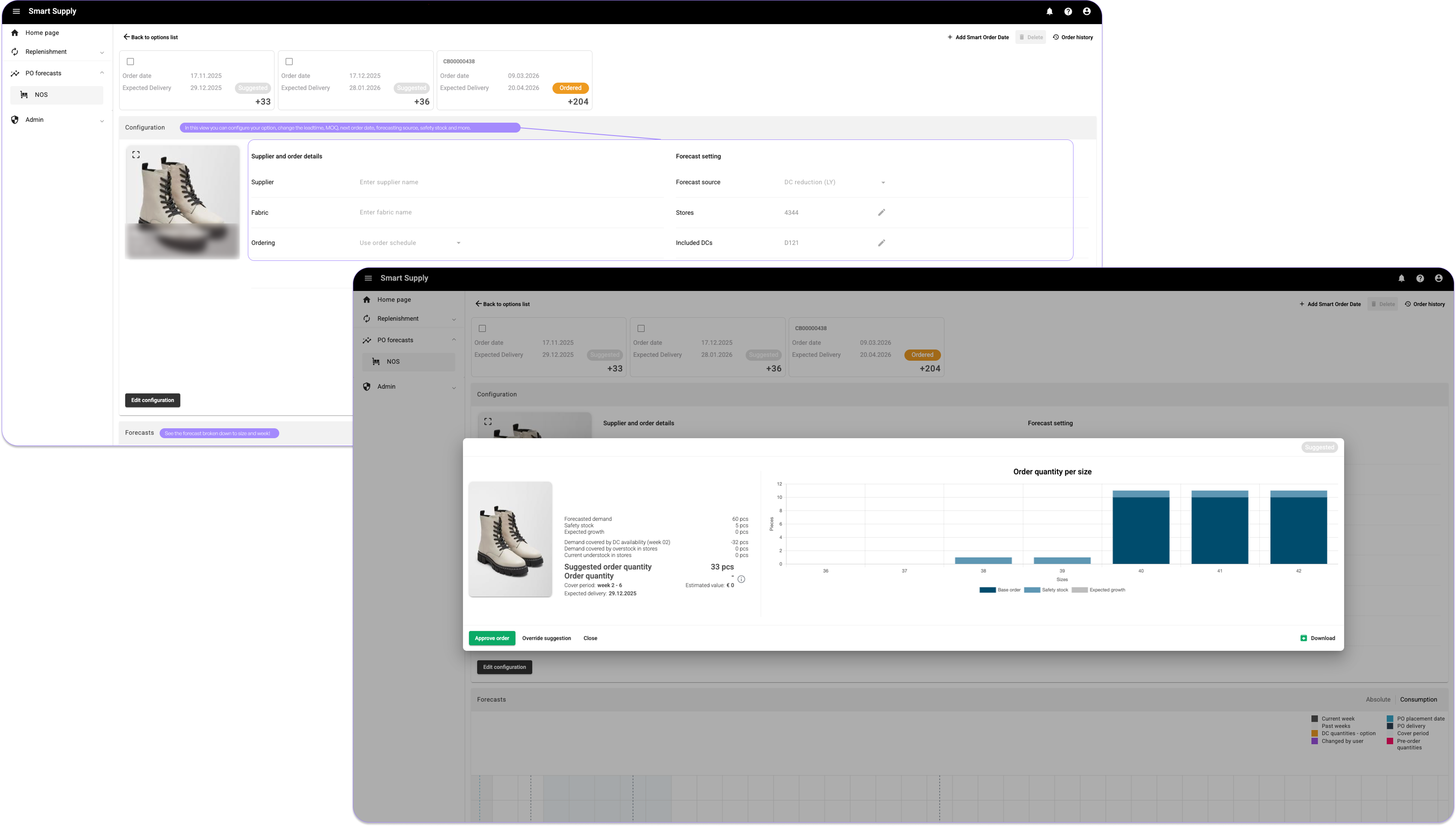
5. Turn forecasts into smarter purchase orders
Once the forecast is calculated, Smart PO Forecasting generates concrete PO suggestions, including quantities, timing and their impact on DC stock. Planners review, apply their business rules such as minimum order quantities or safety stock and approve. What used to take hours of manual work becomes a structured workflow that can be repeated week after week.
6. Improve operational efficiency and free up your team
By automating the repetitive work, you:
- Reduce manual errors
- Save significant planning time
- Give planners space to focus on strategy (e.g. lifecycle management, range decisions)
Automating the mechanics of demand planning frees your team from the grind of spreadsheet maintenance. And the dependency! What happens when the buyer, in charge of the Excel sheet, is on vacation for three weeks? Time and energy move from formula-checking to real questions with Smart PO Forecast: Which NOS lines should we grow? Where do we see declining demand? How do we balance NOS and seasonal items in the same category? Smart PO Forecasting becomes your co-pilot, ensuring that daily demand planning runs smoothly in the background.
7. Make NOS planning part of your sustainability strategy
Better forecasting doesn’t just raise margins; it also supports sustainability. When you produce closer to real demand, you reduce overproduction and markdown volumes. NOS becomes a controlled, efficient flow instead of a warehouse risk. In a market where pressure on sustainability is rising, this is a very tangible lever.
8. Learn from real results
Brands using Smart PO Forecasting typically see:
- Reduced overstock and capital tied up
- Higher sell-through on NOS
- Better size availability and fewer lost-sales situations
The common pattern: once the brands stop guessing and start forecasting at size and option level, NOS turns from a risk into a growth engine.
9. Start small, then scale
You don’t need a big bang rollout. Many brands start with one NOS category, for example denim or sneakers and run Smart PO Forecasting in parallel to their existing method. Once they see cleaner stock levels, better size availability and fewer last-minute corrections, they expand it to more product groups and regions.
Gut feeling is no longer enough in apparel!
To wrap it up: In a fast-changing retail environment, planning NOS with gut feeling and static reports is no longer enough. Smart PO Forecasting gives you a structured way to:
- Plan precisely
- Order confidently
- Run leaner and more sustainably
If you want to turn your NOS portfolio into a reliable, profitable backbone of your business, Smart PO Forecasting is a powerful place to start. Contact us for a demo of Smart PO Forecasting to ensure optimal pre-season management!
Book a free demo and see the live solution!
Get exclusive insights into the Smart PO Forecast Module!
Are you interested in seeing more of Smart PO Forecast? Do you want to streamline your pre-season management?