
And how Chainbalance helps you turn complexity into clarity
“The solution is too complex for us.”
“This will just add more complexity to our processes.”
These are concerns we hear often and they are completely understandable.
In fashion, where operations are already fast-moving and interconnected, introducing a new system can feel like adding yet another layer on top of an already complicated reality. But here’s the key idea:
Complexity doesn’t come from new solutions. It comes from unmanaged processes.
What may look like additional complexity at first is often the starting point of something much more valuable: clarity, structure and control.
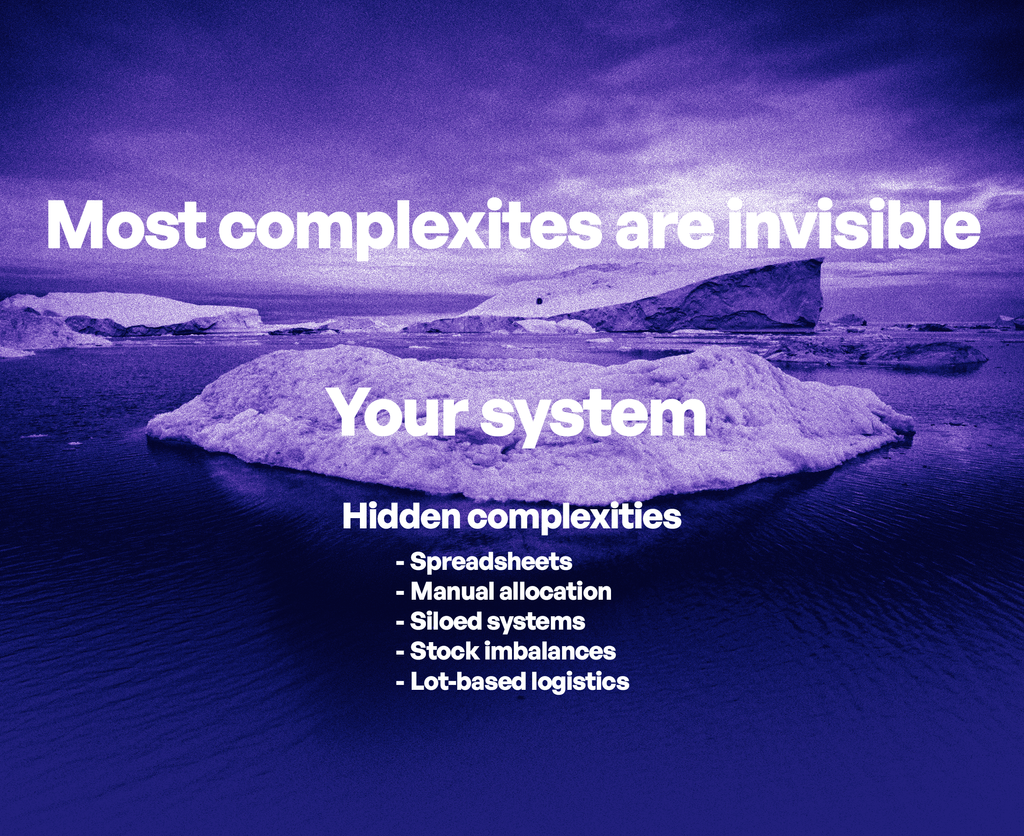
Complexity already exists, it’s just hidden
Most fashion companies are not operating in simple environments today. Why? Because complexity is deeply embedded in the way processes are set up.
It often starts with operational constraints.
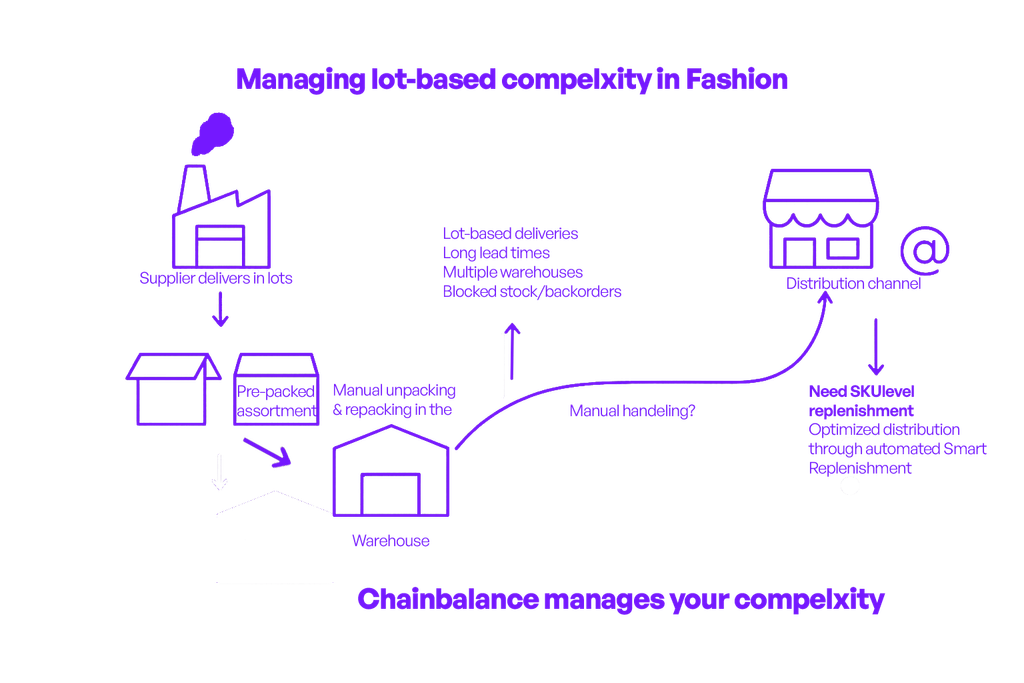
For example, many footwear and fashion businesses receive goods in predefined lots from suppliers. These lots are efficient for production and transport, but they create complexity downstream. Instead of replenishing stores at SKU level, teams need to break up shipments, re-pack items, and manually redistribute products to stores.
At the same time, replenishment itself often only happens in lot-based logic, especially in categories like shoes, making it even harder to react flexibly to actual demand in stores.
Add to that long lead times, which are very common in fashion. When products take weeks or even months to arrive, every decision becomes more critical. Mistakes cannot easily be corrected and teams are forced to plan far ahead with limited visibility.
And then there is the system landscape. Many retailers are working with:
- multiple warehouses
- blocked inventory or reserved stock
- backorders and postponed customer orders
- complex allocation rules across channels
All of this makes operations highly complex to manage and even harder to optimize, because every decision depends on multiple constraints and rules.
Furthermore, this complexity is often hidden in daily operations:
- Manual allocation decisions in spreadsheets
- Limited visibility across stores and channels
- Disconnected systems (ERP, POS, planning tools)
- Time-consuming firefighting when stock imbalances occur
- Heavy reliance on intuition instead of data
Over time, these challenges become “normal.” But they come at a cost: slower reactions, inefficiencies and missed opportunities.
Avoiding new technology doesn’t remove this complexity, it simply keeps it invisible.
The onboarding phase: simplicity from day one
One of the biggest fears around new software is the onboarding phase. Long timelines, heavy IT projects, unclear ownership, this is where many initiatives become overwhelming.
At Chainbalance, onboarding is intentionally designed to feel different.
Instead of a long and uncertain rollout, customers typically go live within six weeks. This is possible because of a structured onboarding approach, supported by our dedicated Customer Success and Operations teams. Rather than relying on complex custom development, Chainbalance connects to existing systems through an established ecosystem, including over 25,000 POS connections and well-integrated ERP and EDI partners.
The result is a process that feels predictable and manageable, turning what is often seen as the most complex phase into a clear starting point.
Where complexity disappears: Smart Merchandise Management
The real transformation happens after go-live, when day-to-day work begins to change.
Instead of manually working around constraints like lot-based deliveries, long lead times, or fragmented inventory, the system integrates these realities into its decision logic.
Replenishment no longer depends on manual calculations or static rules. Instead, target adjustments are calculated and adjusted automatically by our Chainbalance AI based on actual sales data, stock positions and external influencing factors like weather forecasts, seasonality, store and article clustering. Even complex scenarios, such as multiple warehouses, blocked stock or backorders, are considered within one consistent logic.
This shift doesn’t remove complexity from the business itself, retail will always be dynamic, but it organizes complexity in a way that becomes manageable.
At the same time, teams no longer need to reconcile information across systems. They work from a shared, consistent data view and can trust that decisions are based on up-to-date information.
Instead of reacting to issues like stock imbalances after they occur, the system continuously analyzes demand and stock levels, allowing for proactive adjustments.
Over time, something important happens: teams stop spending their time managing complexity manually and start focusing on improving performance.
| Without Chainbalance | With Chainbalance |
|---|---|
| Manual replenishment | Automated replenishment |
| Static planning | Dynamic adjustments |
| Fragmented data | Unified data view |
| Reactive decisions | Proactive optimization |
| Constant firefighting | Exception-based management |
“Doesn’t this still add complexity?”
It’s an important question and the honest answer is: at first, it can feel like it does.
Yes, introducing any new solution brings an initial learning curve. But the difference lies in what happens afterwards.
With Chainbalance:
- Workflows become simpler, not more complicated
- Users interact with intuitive interfaces and clear recommendations
- The system reduces the need for constant manual intervention
What starts as perceived complexity quickly turns into operational simplicity.
A different way to think about complexity
In modern merchandise management, the goal is not to eliminate complexity entirely. That wouldn’t be realistic.
The goal is to shift from:
- fragmented processes to connected systems
- manual decisions to guided automation
- constant firefighting to proactive management
This is where real value emerges, not from doing less, but from doing things in a smarter, more structured way.
Frequently asked questions about Smart Merchandise Management with Chainbalance
Does the Chainbalance Smart Merchandise Management solution increase complexity?
While it introduces a new system, it significantly reduces overall operational complexity by automating manual processes and centralizing data.
How long does it take to implement Chainbalance?
Most customers go live within six weeks thanks to structured onboarding and pre-built integrations.
Do internal IT teams need to be heavily involved?
No. The solution integrates with existing ERP, EDI and POS systems, requiring only minimal IT effort in most cases.
What challenges does Smart Replenishment solve?
It ensures that the right products are in the right place at the right time, reducing stock imbalances and improving sell-through.
Who benefits the most from this approach?
Fashion brands with multiple stores, channels (wholesale, retail, e-com no matter what distribtuion channel) and complex inventory flows see the strongest impact.
So, can you streamline complexity in fashion?
The answer is yes! While complexity in fashion is unavoidable, struggling with it is not.
What may initially look like “just another system” can quickly become the foundation for simpler, more efficient operations. The difference lies in how complexity is managed.
Because true simplification doesn’t come from avoiding change, it comes from embracing the right kind of structure.